
The Score Isn’t the Only Thing Being Judged
The buses are loaded. Garment bags hang like ghosts in the aisle. Someone forgot their black socks. Again. The kids are buzzing, half terrified and half electric. You’ve triple-checked the required judges scores, the percussion equipment, the emergency snacks, and the registration time. You haven’t triple-checked yourself.
In band culture, we talk about tone quality, balance, precision, general effect. We talk about numbers. We talk about captions and rankings and whether the third clarinet entrance in measure 62 was early or just eager. What we don’t talk about nearly enough is the quiet mental toll these days can take on the person standing on the podium.
For many directors, contest isn’t just about students performing. It feels like a referendum on competence, a validation of our worth. On whether the long nights, the missed family events, the second job of paperwork and fundraising meant something. A single rating can start whispering lies: You’re behind. You’re not as good as they are. You’re losing ground. Administration doubts you. Our students begin to lose the intrinsic reward of growth and the pursuit of artistry for the sake of “winning” or being “superior.” That whisper can turn into something heavier over time.
Band contests aren’t inherently unhealthy, especially when used sparingly as a tool for growth for our over-arching musical mission. But when the culture subtly shifts from artistry to validation, from expression to external approval, the director’s mental health can become collateral damage. Especially in an era of shrinking budgets, shifting policies, social media comparison, and community pressure, contest results can feel like survival metrics rather than snapshots of a moment in time, as something that is part of a bigger musical path. The irony? The very people who preach breathing, balance, and centered tone to their students often forget to practice it themselves. We become absorbed in the myth of the festival being our program. Worse yet, we often pretend it isn’t.
Teacher mental health in music education is uniquely complicated. Our work is public. It is audible. It is judged in real time. And unlike a math test quietly graded after school, our “assessment” walks off the stage with applause or polite silence attached to it. That’s a vulnerable place to live year after year. So what might change?
First, we can separate evaluation from identity. A judge’s sheet reflects a performance on a day. It does not reflect your humanity, your creativity, or your long-term impact. Second, we can build colleague cultures where directors talk honestly, not just about repertoire choices and drill design, but about exhaustion, doubt, and pressure and just as important, about our program’s musical path. Third, we can truly redefine success beyond hardware. What about musical growth, listening skills, composer intent and the pursuit of artistry? Not just “winning.”
Contest will likely always be part of band life. The buses will still roll. The black socks will still go missing. But perhaps we can model something different from the podium: not anxiety disguised as intensity, but steadiness rooted in purpose. Because in the end, the most important score isn’t the one announced in the gymnasium: it’s the one we quietly keep inside ourselves.
The content of this Blog article or Banded Story is the intellectual property of the author(s) and cannot be duplicated without the permission of KHS America and/or the author(s). Standard copyright rules apply.
RECENT MILT'S MINDFUL MOMENT POSTS
Milt’s Mindful Moment #12
April Is the Hinge April is a weird month in the music education world, ain’t it? It sits between identities. Not quite the urgency of contest season, not yet the release of final concerts. It’s a hinge. And hinges don’t get much attention until something stops...

Milt’s Mindful Moment #10
Sharpen the Chain I’ve cut a lot of firewood in my life. Enough to know that a chainsaw doesn’t care how motivated you are, how strong you feel, or how badly the job needs to get done. It only cares about one thing: whether the chain is sharp. When it is, the saw...

Milt’s Mindful Moment #9
Part 2 of 2! It’s the beginning of a new year and a new quarter or semester. We’re refreshed from a much-needed break and we’re either excited or fearing what comes next. Course, it’s probably a little of both. When we left off, we were looking a bit deeper at Gnarls...
 We look forward to the evolution of this exciting program, and welcome feedback on how we can further enhance the work that you do in music education.
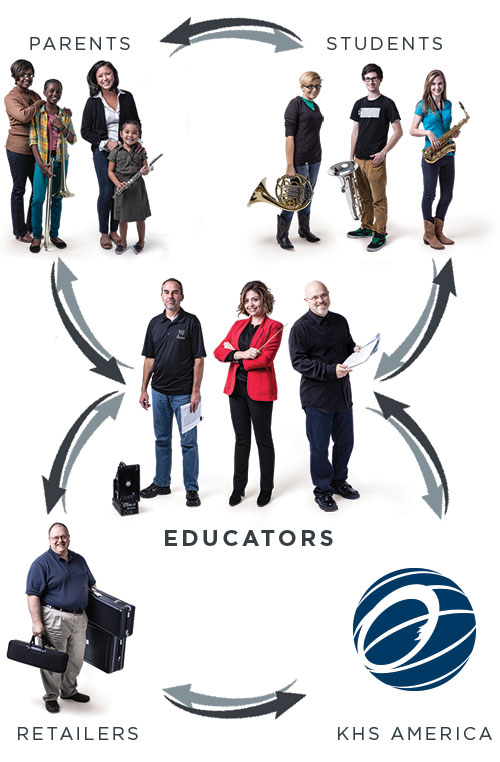
We are excited to offer your program the opportunity to join the KHS America Academic Alliance today.
We look forward to the evolution of this exciting program, and welcome feedback on how we can further enhance the work that you do in music education.
We are excited to offer your program the opportunity to join the KHS America Academic Alliance today.