
They say that being a band director might not be the easiest job in the world. I fear they might be right. As a student that played brass and percussion throughout middle school and high school, I was pretty prepared to tackle those areas in college. However, woodwinds really threw me for a loop. I knew it, my professors knew it, and everyone in the room knew it. When I taught public schools as a band director, I relied heavily on my woodwind friends for any and all tips, tricks, and an occasional repair lesson. I’m very thankful to them for helping me help my students to improve.
These days, as a college professor, a passion of mine is to help band directors find their way in the wacky, wild world of percussion. It can be a lot. It is a lot. There are so, so many wonderful instruments, brands, and methods that you get to discover. It just takes time: the one commodity that you definitely do not have.
I get it. You may have zero time or less than zero time to take care of things. Maybe you have so little time for things that you feel guilty spending time on anything because it takes time away from everything else. My hope is that you consider this an investment of time where you put in a tiny amount now to save a LOT of time (and money) in the future.
Survey Your Kingdom
My suggestion to help improve the sound of your band is through the improvement of the sound of your percussion section. This can begin with making sure that the equipment is functional. Take a lap around your percussion section and survey the items in your charge. Even if you don’t find anything wrong, peace of mind is a resource in itself to be treasured. Even better: take some percussion students with you on your tour so they understand that nothing improves unless we make it improve. They can be your maintenance crew but they have to be trained.
Frequency is up to you, of course. I suggest the beginning of each semester.
Of course, I have many other opinions and recommendations on expanding the ideas below. You’re very welcome to find my email on the internet and send me some questions.
Percussion Equipment Checklist
- Concert Snare Drum
- The top (batter) head should be a 1-ply, coated head. The bottom head should be a 1-ply clear head.
- Check the top head and especially the bottom head for wear-and-tear, puncture wounds (these heads should be replaced).
- Check for rippling around the edges of the head. This means that a lug screw is either detuned or, in some cases, missing! These are very cheap and easily replaced.
- If the snare doesn’t sound great: usually, the bottom head is too loose. I tune my bottom head until I hear an “A” pitch. Once this is done, loosen and/or tighten the snares to where it sounds best.
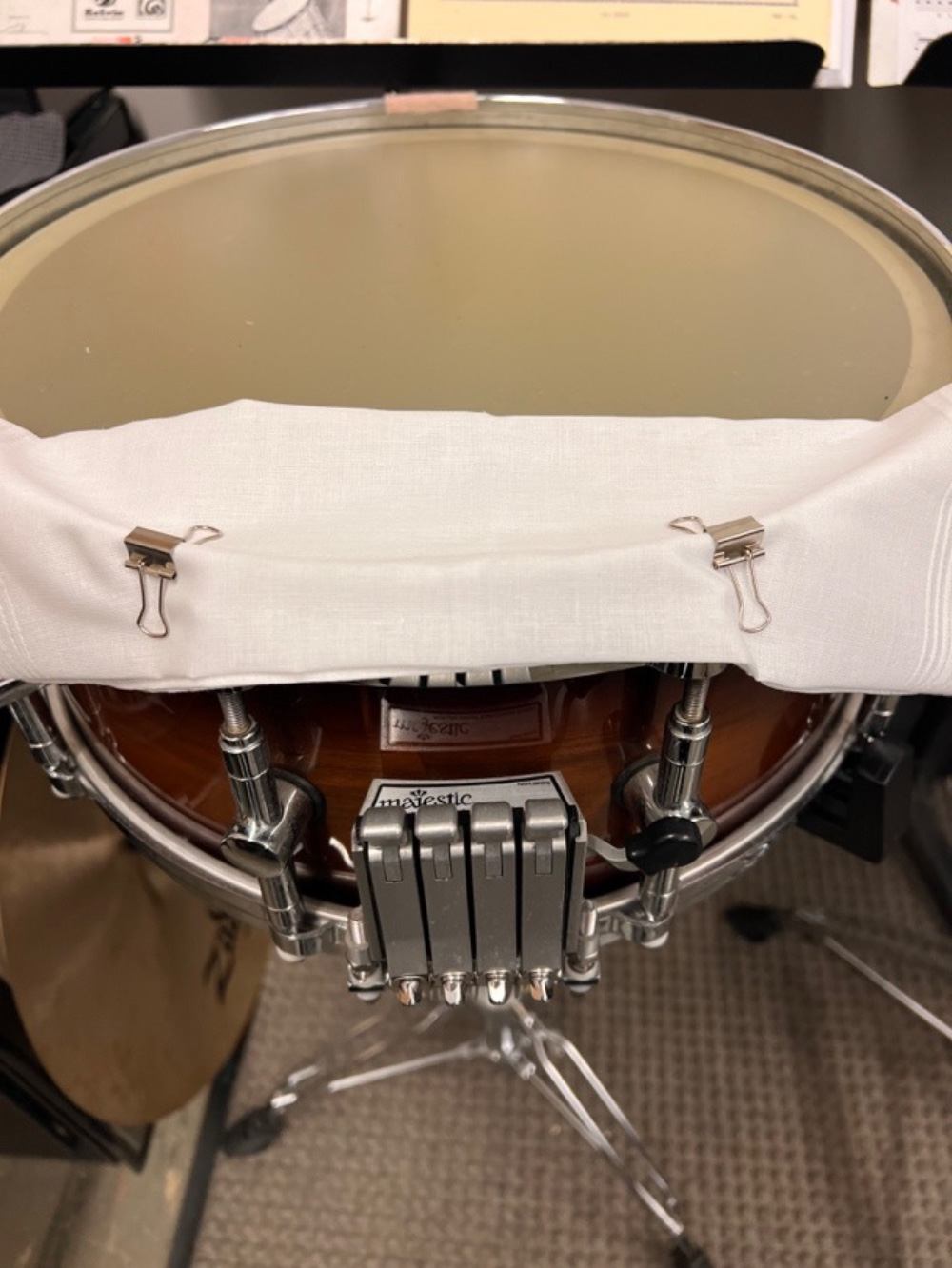
- YES, your concert snare drum needs muffling. Please don’t let your students to use a wallet. I like to use a cheap handkerchief, folded up, and clipped to the snare drum rim with binder clips.
- Concert Bass Drum
- Your drum should have a low, warm boom sound. If it sounds like a tissue box, tighten the batter head. Don’t be afraid to tighten the resonant head (the one that no one ever touches).
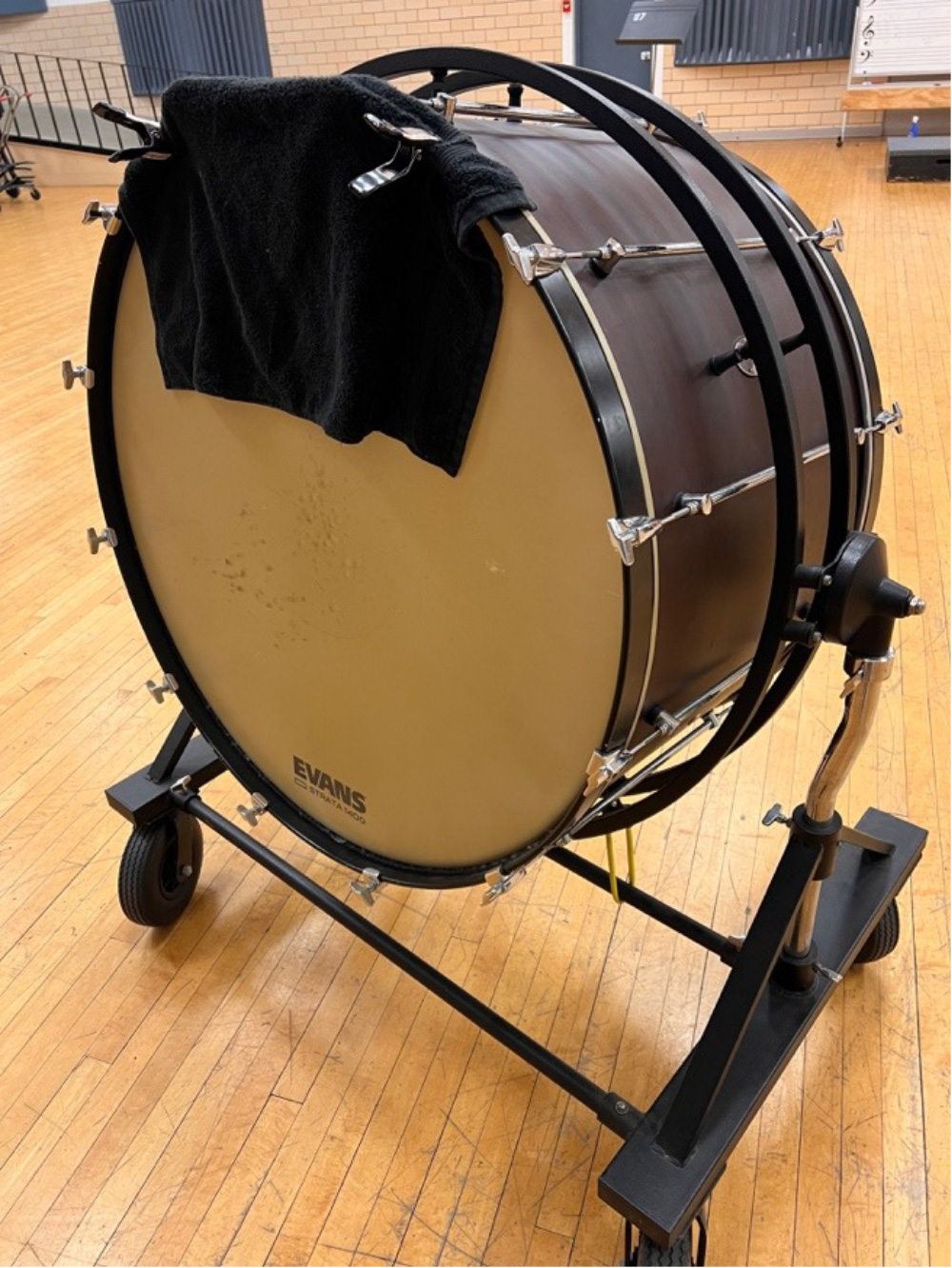
- Keep a black hand towel or black bathroom towel clipped to the hoop for muffling.
- Congas/Bongos
- Acquire a conga wrench! This is around the same investment amount as a drum key. Keep it in your desk next to your timpani key and drum key(s).
- A lot of these instruments have a skin head which have the potential to sound great. Temperature and humidity affect the tuning, just like your woodwind instruments. If it sounds like a tissue box, take your wrench and crank it.
- Timpani
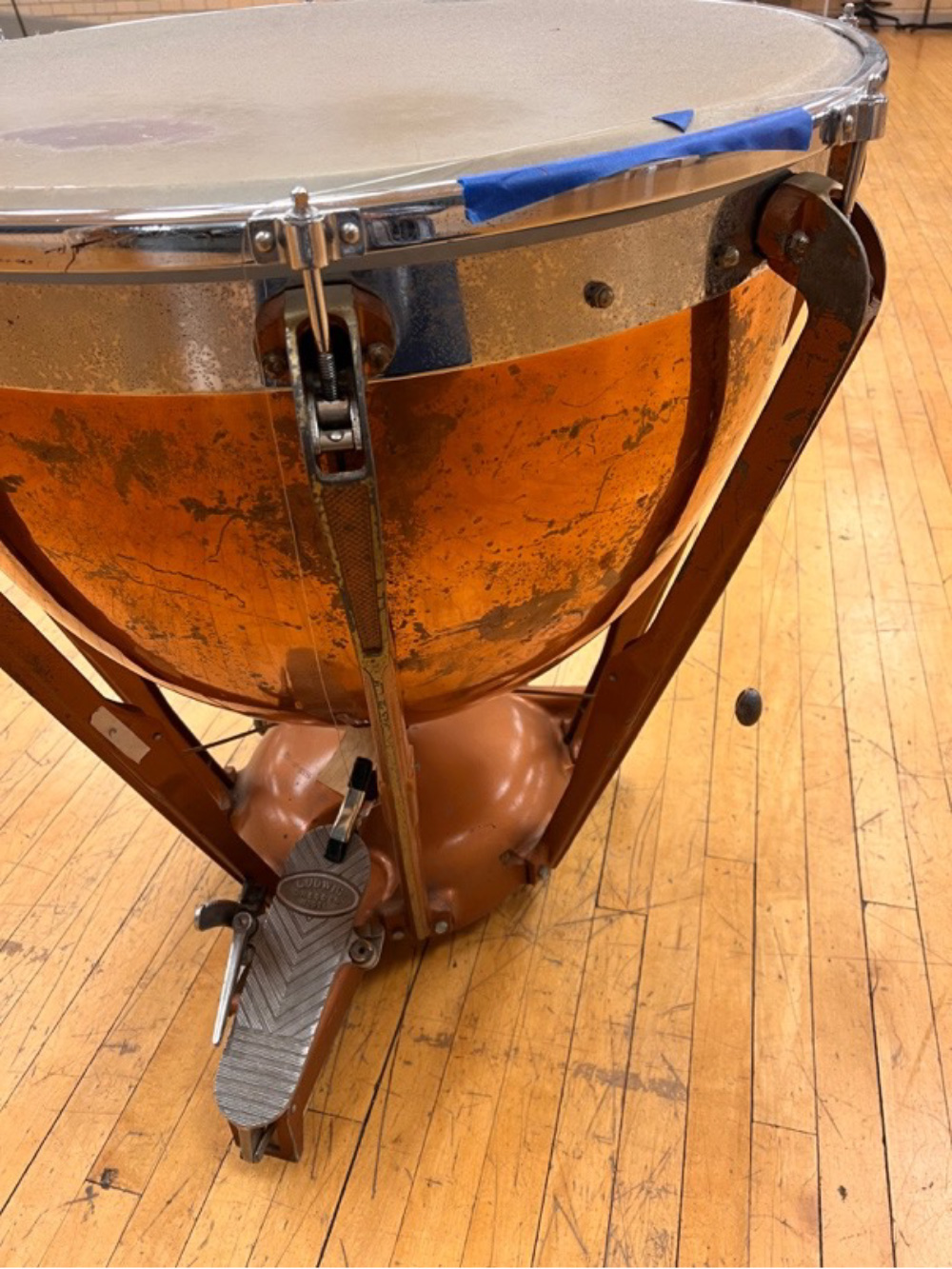
- The most common problem I see is that the pedals refuse to stay where you put them. Usually, this simply means that the drums are not in the correct ranges. Do not mess with the pedal tension knob in the base of the instrument unless you know what’s going on.
- The bottom notes on each timpano (this is the correct term for a singular drum) spell out a Bb chord in 1st inversion and each drum holds around the interval of a 5th:
- 32”: D – A
- 29”: F – C
- 26”: Bb – F
- 23”: D – A
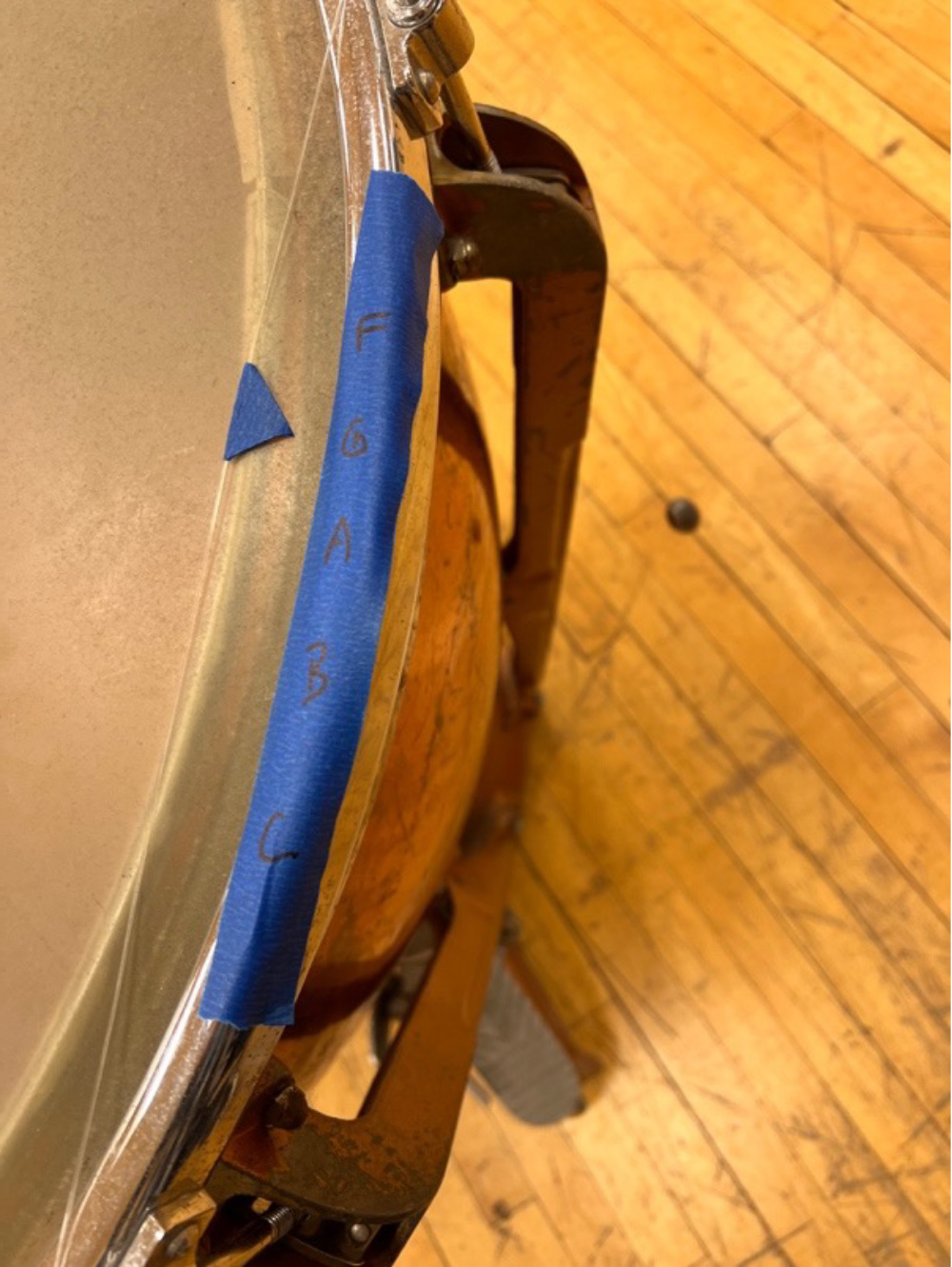
- If your timpani don’t have gauges, that’s a great opportunity for ear training! You can also make gauges on the cheap that help students get close. All you need is a metal spring clamp, some painter’s tape, some heavy-duty fishing line, a fishing weight, and a sharpie:
Take about five feet of heavy fishing line, tie one end to the metal spring clamp and the other end to the fishing weight. Put the clamp on the “toe” of the timpano pedal. String the fishing line by the lug screws. Place some painters tape on the hoop next to the path of the fishing line and label your notes. - Yes: Your students need a timpani stool. They do. Even if they say they don’t, they do.
- Cymbals
- In your annual budget, have space for the things that love to walk away: cymbal stand washers, wingnuts, felts, and plastic sleeves. I purchase these every year, even at the collegiate level because these things go missing constantly.
- Over time, playing suspended without these items will cause cracks in the cymbal, destroying your expensive investment over time. Cymbals are easily capable of surviving for decades and beyond if taken care of.
- You need a crash cradle for your crash cymbals. Otherwise, they can easily end up in the floor where bad things happen.
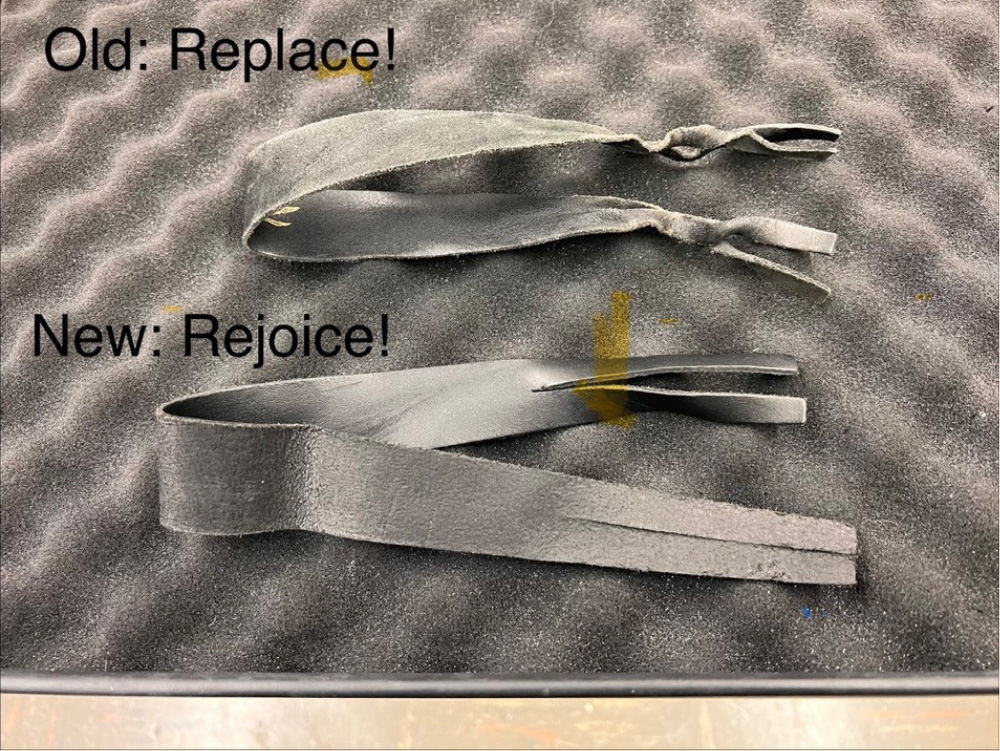
- Check crash cymbal straps for wear and rot. The cheaper leather straps are great and hold up for a long time. If you want to keep those straps around longer, have your students simply use a matched snare drum grip on the straps. They do not need to put their hand through the loops like we do in marching band.
- Accessories
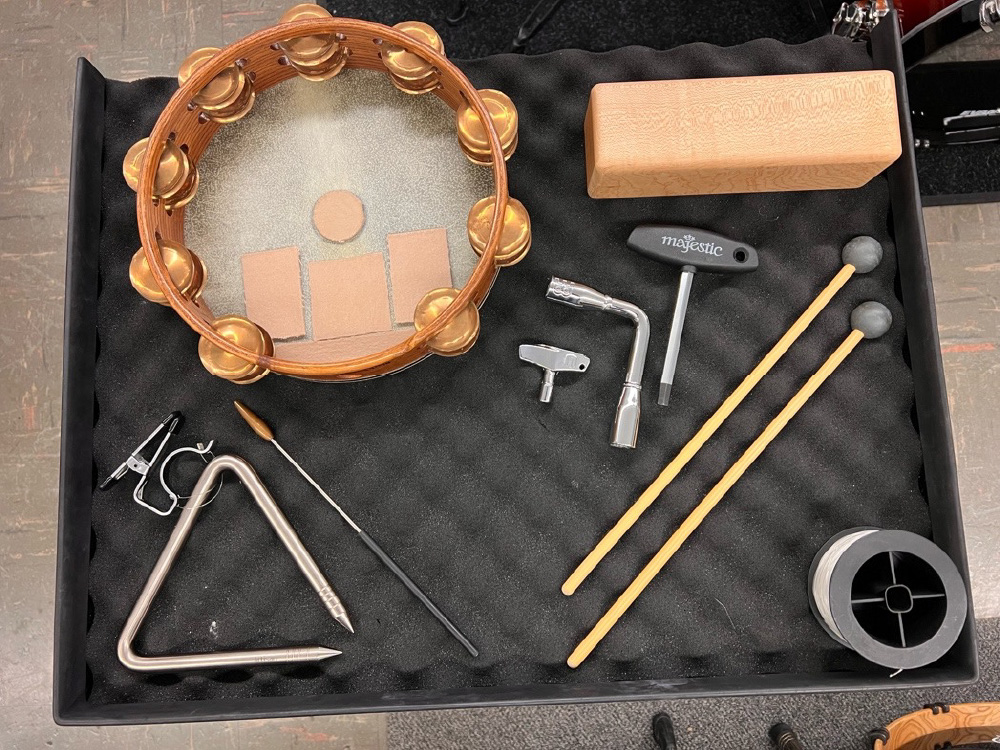
- Triangles should have a proper clip and beater. It doesn’t have to be expensive; it just needs to work. If you have a clip with broken string, a great replacement is that heavy-duty fishing line from making timpani gauges. Remember: the pros make two loops, just in case.
- Woodblocks, just like drum sticks, do not last forever. Inspect your wood block for visible cracks. If it has a crack or has a dead sound, replace it.
- There are a lot of great tambourines in the world. A lot of tambourines suffer from the same issue as the congas & bongos: a skin head. If my tambourine sounds like a tissue box, I’ll grab my heating pad and use it on the head to tighten things up. Just be careful and attentive.
- If your tambourine head has been ripped or punctured, you can easily acquire a replacement head. The only replacement head you can currently get will be a skin head. From experience, it can be a fun experience for you and your students to replace it. Make it a fun science experiment.
- Trap Table
- Using music stands can work in a pinch for trap tables. I’ve done it a million times. I’ve also seen a poorly functioning music stand drop those instruments or mallets a million times. There are some great companies out there that make trap tables specifically for percussion. These are great investments. Otherwise, instruments can end up in the floor and broken.
Help! I Need Somebody!
If you’re really, really lost on percussion, I can suggest some bonus paths. Please remember that your quest for knowledge is all for your students. That’s our charge. That’s why we’re in this business. Don’t let unfamiliarity in a certain instrument family limit your ability to connect with students and help them along their path.
- Find some directors in your district to trade with. Offer to have a sectional or lessons for their students in your primary area. Trade this for an afternoon of percussion basics or the like.
- Contact your local university! We’re also burning the candle of both ends but I’m always on the lookout for schools to visit or places where I can send some of my college students to get some teaching experience. It’s especially beneficial when there’s a Saturday where I or my students can come visit a program and help sift through the old hardware and instruments to see what is actually usable. I’ve found some true treasures over the years doing this. If you don’t receive a reply, email again. The email filters are very intense, these days.
- Search out the state chapter of Percussive Arts Society. Most states hold an annual PAS event where your students (and you?) will get inspired from clinics and performances. They’re even offering group memberships now. Take advantage!
In closing, the bottom line is that even with such precious little time, there is a true investment possible here that will pay you and your students back for time spent. On most other instruments, equipment can be bypassed in some ways – but in the percussion section, nothing can stand against well-maintained equipment and well-trained percussionists to guarantee that things are in working order every year.
DR. BEN CANTRELL currently serves as Assistant Professor of Percussion at Morehead State University where he, along with fellow percussion faculty member Dr. Brian Mason, teaches private lessons, percussion ensemble, and steel band. He also serves as the music teacher for MSU’s Upward Bound program, director of the MSU Pep Band, and director of MSU’s Summer Arts Academy.
As a performer, he has played with numerous ensembles across the U.S. as well as multi-city tours in Europe and Asia. Ben is currently a member of the Cave Run Orchestra in Morehead, KY and the Sacred Winds ensemble of Somerset, KY. Previously, he has performed in the Roanoke Symphony Orchestra, Winston-Salem Symphony, Greensboro Symphony Orchestra, the Piedmont Triad Jazz Ensemble, Woodford Theatre, Jenny Wiley Theatre, and Barter Theatre of Abingdon, VA. Other notable performances include those at KMEA, NCMEA, the Virginia/DC Day of Percussion, North Carolina Day of Percussion, and the Jazz Educator’s Network Conference.
As a clinician, Dr. Cantrell regularly visits with many high school and middle school programs throughout Kentucky. Recent events include being the percussion clinician at KMEA District 9 All-District Band, KMEA District 8 All-District Band, Concord University Honors Band (Athens, WV), Cedar Cliffs Percussion Day (Asheville, NC), and the Western Kentucky Percussion Festival.
As a member of the Percussive Arts Society, Ben reviews new literature for their official journal, Percussive Notes. Ben would like to thank all of the wonderful companies for which he is an educational artist: Mapex/Majestic Percussion, Innovative Percussion, Evans Drumheads, Black Swamp Percussion, and Zildjian Cymbals.
The content of this Blog article or Banded Story is the intellectual property of the author(s) and cannot be duplicated without the permission of KHS America and/or the author(s). Standard copyright rules apply.